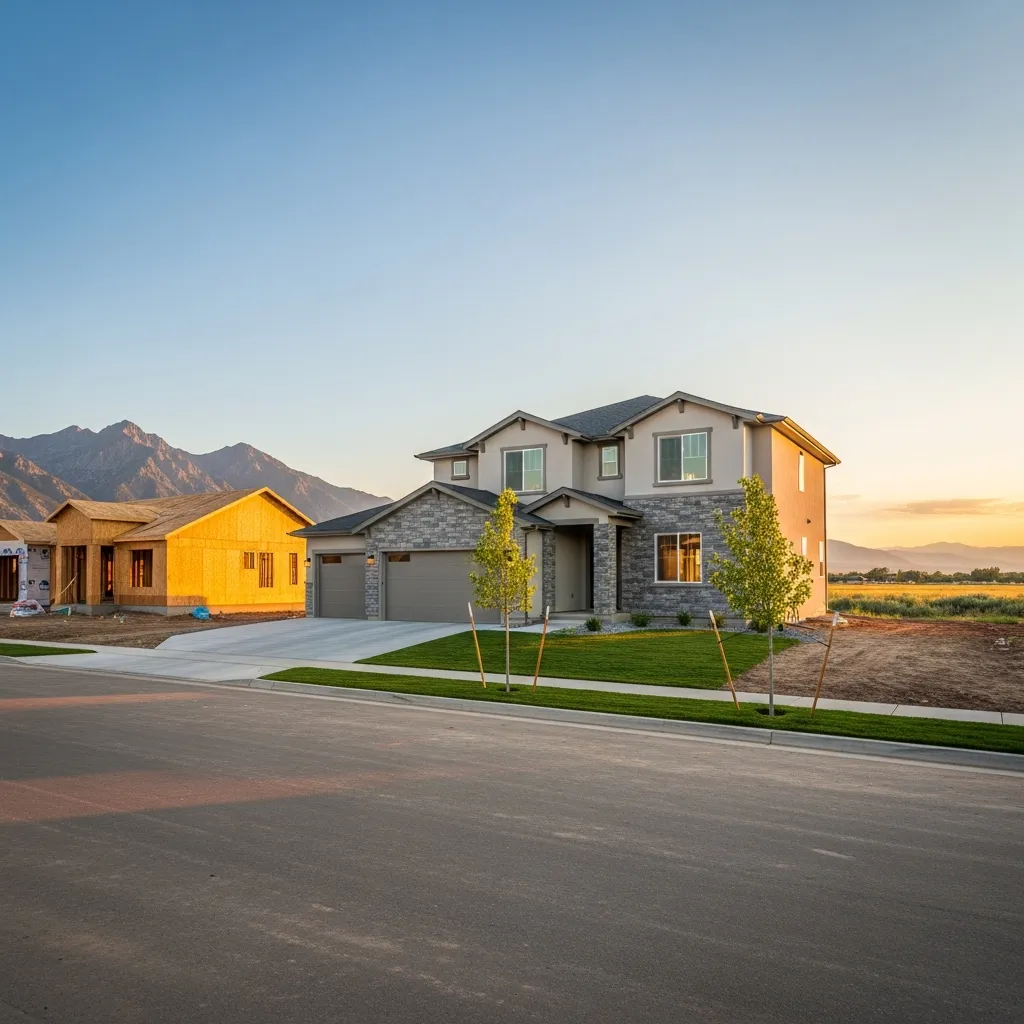
How to Use Utah's $20k Grant to Buy a New Home in Eagle Mountain
Eagle Mountain has more dirt moving than anywhere else on the Wasatch Front right now. Cranes everywhere. Streets going in. Models popping up faster than you can tour them. And if you drive down Porter's Crossing Boulevard or Pony Express Parkway on a Saturday, you will see the parade of hopeful buyers walking through those model homes, doing the math in their heads, and then walking back to their cars with that same defeated look.
Because the math is brutal right now.
Mortgage rates are sitting around 7% as of this writing. A $400,000 home at 7% with 5% down means a monthly payment north of $2,700 before HOA fees. For a first-time buyer making $80,000 a year, that is a stretch that feels more like a tear.
But here is the thing nobody is talking about loud enough: Utah has a $20,000 grant program specifically for first-time buyers purchasing new construction. And Eagle Mountain is one of the only cities on the Wasatch Front where you can actually find new homes that qualify for it. Not Lehi. Not Draper. Not Herriman. Eagle Mountain.
If you know how to stack that state money with the builder incentives that are quietly available right now, you can drop your monthly payment by hundreds of dollars and actually make this work. No magic. Just strategy.
The Real Cost of a 7% Mortgage Rate
Most people focus on the sale price of the home. But the interest rate is what kills you every month.
A $400,000 home at 7% interest with a 5% down payment ($20,000 down) leaves you with a $380,000 loan. Your principal and interest payment alone is about $2,530 per month. Add property taxes in Eagle Mountain (roughly $250/month), insurance ($150/month), and HOA fees ($100-$200/month depending on the neighborhood), and you are easily over $3,000 per month.
To qualify for that comfortably under most lender guidelines, you need a household income around $100,000 or more. That is out of reach for a ton of first-time buyers, especially younger couples or single buyers just starting out.
The difference between 7% and 5% on that same loan? About $410 per month. Over the course of a year, that is nearly $5,000 in your pocket instead of the bank's.
So the question is not whether rates are high. They are. The question is how you can artificially lower your rate using programs and incentives that actually exist right now.
What Is Utah's $20,000 First-Time Homebuyer Grant?
Utah passed Senate Bill 240 to help first-time buyers afford new construction. The program is run through the Utah Housing Corporation, and it gives eligible buyers up to $20,000 in the form of a second mortgage.
Here is how it works:
The $20,000 is a loan. But it charges 0% interest. You do not make monthly payments on it. It just sits there as a lien on your home. If you sell the home or refinance within the first few years, you have to pay it back. But if you stay in the home for a certain period (the terms vary depending on which version of the program you use), a portion or all of it can be forgiven.
You can use the money for three things: down payment, closing costs, or a permanent rate buydown.
But there are rules. Big ones.
The home must be new construction. It must be your primary residence. The purchase price cannot exceed $450,000. And you must be a first-time homebuyer, which in Utah means you have not owned a home in the last three years.
This is where Eagle Mountain becomes the obvious play. Because unlike Lehi or Saratoga Springs, where new builds are regularly pushing $500,000 to $600,000, Eagle Mountain still has entire developments with townhomes and starter single-family homes priced between $380,000 and $440,000.
Pony Express, SkyRanch, The Ranches, Porter's Crossing - all of these neighborhoods have inventory that fits the bill. And builders are still competing hard for buyers, which means incentives are on the table if you know how to ask.
How to Stack the Grant with Builder Rate Buydowns
Here is where it gets interesting.
Most buyers think they have to choose: either take the state money or take the builder incentive. But that is not true. You can use both.
Here is the strategy:
Use the $20,000 from the state as your down payment. That gets you to 5% down on a $400,000 home without touching your savings. Then negotiate with the builder to pay for a temporary 2-1 rate buydown using their seller concessions.
A 2-1 buydown means your interest rate is reduced by 2% in year one, 1% in year two, and then it goes to the normal rate in year three. So if the market rate is 7%, you pay 5% in year one, 6% in year two, and 7% after that.
The builder pays for this upfront by covering the difference in interest for those first two years. It typically costs the builder around $10,000 to $15,000 depending on the loan size. And right now, many builders in Eagle Mountain are offering $10,000 to $20,000 in closing cost credits to move inventory.
So you take the state's $20k for the down payment. You take the builder's $15k concession and apply it to the 2-1 buydown. Now your first-year payment on that $400,000 home drops from $2,530 to around $2,150. That is nearly $400 per month in savings during the year when your budget is tightest.
And because the $20k from Utah is structured as a second mortgage, it does not count against your debt-to-income ratio the same way a traditional loan does. That can help you qualify for the first mortgage more easily.
This is not theory. We have helped buyers do exactly this in the last six months. One couple in SkyRanch used this exact stack to bring their payment under $2,800 all-in on a brand new three-bedroom townhome. They would not have qualified otherwise.
The Builder Lender Trap You Need to Avoid
Builders love to tie their incentives to using their preferred lender. And sometimes that is fine. But sometimes it is not.
Here is what happens: The builder offers you $15,000 in closing costs, but only if you use their in-house lender. Sounds great. But when you get the Loan Estimate from that lender, you see the base interest rate is 7.25% instead of the 7% you were quoted by your own lender. Or the lender fees are $3,000 higher. Or they are charging you for a rate lock extension that your local lender would not.
The incentive is real. But so is the markup.
You need to compare Loan Estimates side by side. Not just the interest rate. Look at the APR, which includes fees. Look at lender charges, title fees, and any junk fees buried in Section C. If the builder's lender is costing you an extra $5,000 in fees or a quarter point in rate, that $15,000 incentive is not worth as much as it looks.
We always tell buyers to get pre-approved with their own trusted lender first, then take that Loan Estimate to the builder's lender and say, "Beat this." If they can, great. If they cannot, you have leverage to ask the builder to let you use your own lender and still get part of the incentive.
Some builders will budge. Some will not. But you will never know unless you ask. And if you are working with someone who knows how to have that conversation - hint, that is what a buyer's agent does - you have a much better shot at keeping both the incentive and the better loan terms.
Why Eagle Mountain Is the Only Place This Works Right Now
This strategy only works if you can find new construction under $450,000. And on the Wasatch Front in 2025, that is a short list.
Lehi? Forget it. Even the townhomes are pushing $475,000 now. Herriman? Same story. Saratoga Springs? You might find a condo, but good luck finding a single-family home under the cap.
Eagle Mountain is different. The city has over 50 square miles of developable land. Builders like Visionary Homes, Ivory Homes, Edge Homes, and Woodside Homes are all active here, and they are building at different price points to capture different buyers. You can still find attached townhomes starting in the high $300s and detached homes in the low $400s, especially in the northern developments near Pony Express Parkway.
And because there is so much competition among builders, the incentives are better. When five builders are fighting for the same buyer pool, they get creative. Rate buydowns. Closing cost credits. Free finished basements. Upgraded flooring. These are not advertised on the website. You have to ask. Or better, have someone ask for you who does this every week.
The I-15 commute from Eagle Mountain is not short. Anyone telling you otherwise is lying. But if you work remote a few days a week, or your job is in Utah County instead of Salt Lake County, it is completely manageable. And the trade-off is that you can actually afford to buy a home instead of renting in Riverton for another three years waiting for prices to drop.
How Salisbury Real Estate Helps You Stack the Programs
This is not a strategy you can execute by walking into a model home alone on a Saturday.
Builders have their own agents sitting in those models. Those agents work for the builder. They get paid when the builder sells a home. They are nice people. But they are not your advocate.
When you walk in with your own buyer's agent, the builder still pays the commission. It costs you nothing. But now you have someone who knows how to negotiate the rate buydown, structure the offer so the state grant fits cleanly, and review the Loan Estimate from the builder's lender to make sure you are not getting taken.
Cory handles the builder negotiations and walks you through the purchase agreement and all the builder addendums, which are always tilted in the builder's favor. Jenni keeps the timeline tight as Office Manager, making sure the grant paperwork is submitted on time, the builder is hitting deadlines, and your lender has everything they need before the closing date sneaks up on you.
We also work with two local lenders who are very familiar with the Utah Housing Corporation programs and know how to structure the loan so the $20,000 second mortgage does not create underwriting issues. That matters more than you think.
And if you are wondering what other first-time buyer programs are available in Utah, we can walk you through all of them. Some stack with S.B. 240. Some do not. It depends on your income, your down payment, and what you are buying.
The Window Will Not Stay Open Forever
The $20,000 grant program is funded by the state, and the funding is not unlimited. When it runs out, it runs out. The last time Utah Housing had a similar program, it was gone in under two years.
And builder incentives are tied to inventory. Right now, builders in Eagle Mountain have specs sitting finished and ready to close. They want them gone. That is why they are willing to pay for rate buydowns and closing costs. But once that inventory moves, the incentives shrink or disappear.
If you are a first-time buyer and you have been sitting on the sidelines waiting for rates to drop or prices to fall, you are going to be waiting a long time. Rates might come down half a point in the next year. Or they might not. prices in Eagle Mountain are not falling. They are just growing slower than they were two years ago.
The play is not to wait for perfect conditions. The play is to use the tools available right now to make the current conditions work for you.
You can sit in a $1,800/month rental and hope things get better. Or you can sit in a $2,800/month mortgage on a brand new home that you own, that is building equity, and that you got into using $20,000 of the state's money and a rate buydown that saved you $5,000 in year one.
We know which one makes more sense. If you want help running your numbers and figuring out what you actually qualify for in Eagle Mountain, reach out and we will walk through it with you. No pressure. No sales pitch. Just real numbers and a real plan.
Cory Salisbury | Realtor® - Equity Real Estate
